
Arctic Sea Average Temperatures
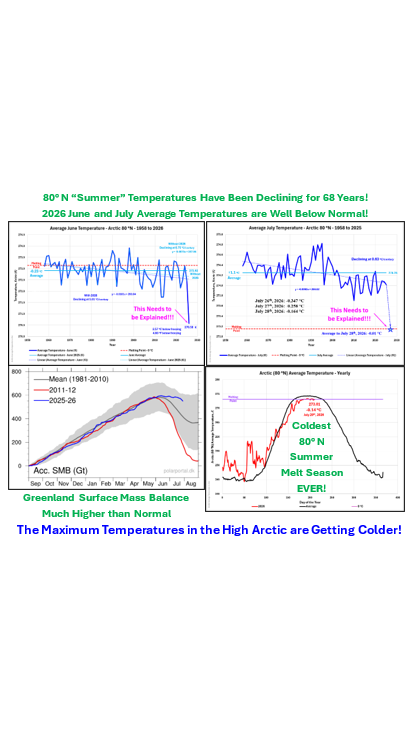
CSS-84 The temperatures in the high Arctic (80° N) have been anonymously and significantly low during this summer’s melt season. The LOWEST EVER to use typical climate alarmist parlance, barely/rarely piercing ice’s melting point. June was 2.34 °C colder than the 1968 to 2025 average, July will close out roughly 1 °C below average. On its own, not a trend, but the temperatures in all three summer melting months (June, July, and August) have been trending colder over the entire 68-year data history. June is trending colder at 0.75 °C/century, July at 0.63 °C/century, and August at 0.04 °C/century. That cold has extended down into Greenland, where Surface Mass Balance has also been anonymously higher than normal with a significantly delayed melt season.
#climatechange #delaythegreen #globalwarming #showusthedata
The high Arctic is not cooperating with the All CO2, All the Time alarmist narrative and has not been cooperating since record keeping began in 1958. Average temperatures have been increasing. But that increase is due to warming during the 9 months that rarely if ever melt. The summer high temperatures have all declined over the last 68 years. August is actually statistically flat at -0.04 °C/century but had been declining at 0.43 °C/century up until 2018 (with a strong, sustained warming pulse since then). Neither CO2 nor any other anthropogenic forcing are responsible for that warming pulse. Hard to imagine that the high Arctic will be ice free anytime soon, given the melting period has been cooling for 68 years. Significant melting temperatures (just ±1 °C, and declining) are now focused on July alone. Note, July (this year) closed out with a temperature below the melting point (-0.014 °C). The Arctic Sea will not be burning nor boiling anytime soon.
Long term, the overall High Arctic temperatures have been moderating. The moderation is due to warming during the extreme cold of the winter season and the moderate cold of the spring and fall cold seasons. Realistically, the High Arctic has a nine-month winter season and three months of minor spring weather. Warming during that winter season is just beneficial for whatever life is trying to survive those extreme cold conditions. The bigger risk to life is the continued temperature declines in the brief but still cold summer months. This general pattern plays out in many areas around the world. Maximum temperature (and/or daily high) trends tend to remain statistically flat over time with the warming occurring during the colder portions of the year and/or at night. As an aside, the many studies that show cold kills ±10 times more people than heat kills does not apply directly to the High Arctic’s very minor human population. But the general profile, minor to no rise in maximum temperatures during the warm months and noticeable warming during the cold months, just saves lives elsewhere.
Are we starting to see the beginnings of the next Heinrich cooling event? The Atlantic Multi-Decadal Oscillation (AMO) and the Grand Solar Minimum (GSM) cycle are both headed into their cold phases. Also, the recent, current temperature rise (1 to 1.5 °C out of the Little Ice Age) is consistent with every other sharp temperature rise that corresponds to the ±1,100-year Bond/Eddy Solar cycle highs. Those sharp temperature rises are quickly followed by sharp temperature drops into a long pronounced cold period. These Heinrich events are thought to be triggered by accelerated iceberg drifts into the mid latitudes but may also be affected by a major release into the North Atlantic of the cold, fresh water currently trapped in the Beaufort Gyre. Either event could disrupt the flow of the Atlantic Meridional Overturning Current (AMOC) triggering cold throughout the Northern Hemisphere. All these processes are currently being and have in the past regularly played out. The one place you will not see these real-world events is in the climate models. Those very models that have been self acknowledged to run too hot and use unrealistically high emission scenarios.
The real world is complicated and the other non-anthropogenic options (that are knowingly ignored by the alarmist community) can not be explained in a paragraph or two. There is a set of links included below that discuss these other options in much more detail. The focus of this post has been the anomalous cold in the High Arctic (80° N) this year and the long, well established cooling trends that are present throughout the “warm” summer/melting months. These High Arctic temperatures do not fit the All CO2, All the Time alarmist narrative and need to be explained.


DMI – Polar Portal – Surface Conditions

CSS-71 – IPCC Model/Theory Shortcomings – Revisited
CSS-74 – Climate Tipping Points
CSS-75 – Solar Forcing Discussion
CSS-78 – Weakening Electromagnetic Field
CSS-79 – A Commonsense Look at Climate Change
OPS-83 – Holocene CO2 and the Magnetic Field
Climate Short Story (CSS)
CSS-69 – CO2’s Cooling Parameters
CSS-71 – IPCC’s Model/Theory Shortcomings
CSS-71 – IPCC’s Model/Theory Shortcomings – Revisited
CSS-74 – Climate Tipping Points
CSS-75 – Solar Forcing Discussion
CSS-78 – Weakening Electromagnetic Field
CSS-79 – A Commonsense Look at Climate Change
CSS-82 – Building a Better, More Realistic Climate Model
One Page Summary (OPS)
OPS-80 – CO2 Affects Temperature but Does CO2 Drive Climate?
OPS-83 – Holocene CO2 and the Magnetic Field


