
Forest Fire Interim Update – August 2026
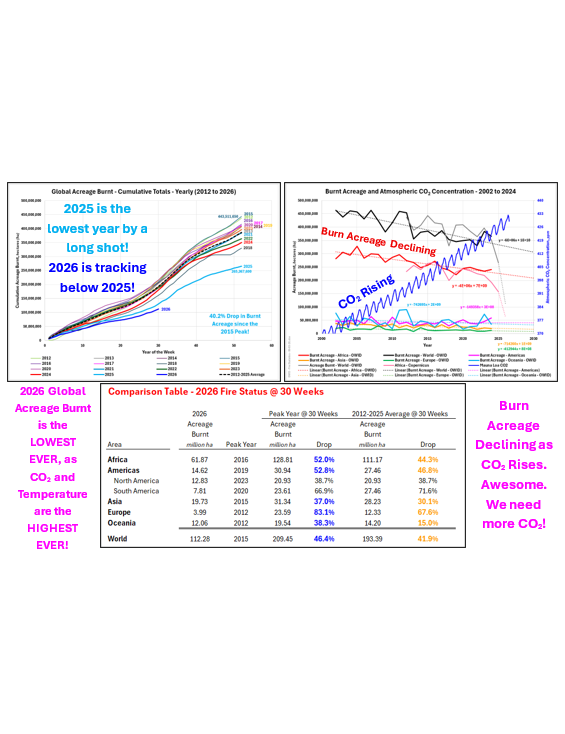
CSS-85 Surprise, summer can be hot, prone to enhanced fire conditions, and laden with apocalyptic ‘climate change’ propaganda. This northern summer has followed suit. But is the global fire situation really following the All CO2, All the Time alarmist narrative. Not even close, regardless of how many burning forest pictures and videos get posted. Global acreage burnt and the number of fires has been falling since the turn of the century with 2025 being the ‘LOWEST YEAR EVER’ (using alarmist parlance) and 2026 tracking significantly lower than 2025. All despite the steady rise in atmospheric CO2 concentrations and human emissions.
#climatechange #delaythegreen #globalwarming #showusthedata
The global acreage burnt data is summarized in the attached image. As shown in the table every continent (Antarctica not included for obvious reasons) shows acreage burnt has declined steadily since 2002. The 2026 burnt acreages are significantly lower than the 2012 to 2025 average on every continent. A maximum of 67.6% lower on the European continent (fires in France and Spain, not withstanding) and a minimum of 15% lower in Oceania (essentially Australia). The 2025 burn season has been the lowest this century in Africa, the Americas, Asia, and Europe and roughly average in Oceania (a small portion of the world’s land area). The 2026 burnt acreages are the LOWEST EVER (using the alarmist nomenclature) in Africa, the Americas, and Europe and close to the LOWEST EVER in Asia and Oceania.

The empirical fire data does not support the All CO2, All the Time alarmist narrative. Period. Try and find a news report that does not tie ‘climate change’ to every extreme weather event. They are few and far between. Why is the link between ‘climate change’ and extreme weather virtually always included? That is the first law of narrative building. Repeat the narrative forcefully and often until the general public eventually buys into the ruse. The fires in Spain, France, Canada, etc. are worth reporting on, but news flash, the narrative that there is a link between ‘climate change’ and extreme weather is not news given the years of incessant propaganda. Ultimately, the empirical data has proven that the ‘climate change’/extreme weather link is just pseudoscience at best.
Even the IPCC does not see any trend to more fire weather within the historical data. They do not even see any fire weather trend in their forecasted data as shown in Table 12.12 from the 2021 AR6 report. And they were still using the implausibly high RCP8.5/SSP5-8.5 emission scenario. Their WET and DRY Category (which includes Fire Weather) has been attached. A more detailed discussion on Table 12.12 is included in my CSS-64 – IPCC – Chapter 12 – Extreme Weather post. Personally, I feel the IPCC is being disingenuous by not recognizing the obvious declining global acreage burnt values. There has been a 42.7% drop in acreage burnt globally (198 million hectares). That s not a trivial change. There may well be a link between ‘climate change’ and forest fire status, but there are obviously far more dramatic influences that are being ignored or minimized in the reporting. Note, the IPCC’s confidence in the vast majority of extreme weather event trends falls solidly into the Low Confidence in the Direction of Change category
This post goes into a lot more detail, focusing in on a few areas/countries (Canada, USA, Australia, and the EU). They all show the same basic truth. While locally, these fires can be tragic and physically devastating, our “greenhouse gas” emissions have little to do with how much acreage gets burned on this planet. Humanity is responsible for a great many of the worst fires because very simply we start most of those fires (accidently and/or intentionally) and we generally start them near where we live. If the forests are densely populated, the damage is going to be significantly higher than a wilderness area. That is a risk/reward game humanity plays when choosing to live in harm’s way, not ‘climate change’. You choose to live in a forest; there will be a forest fire risk.

Canadian National Fire Database – NFD
European Forest Fire Information System – Copernicus – EFFIS
Global Wildfire Information System -GWIS
Our World in Data – Fire Statistics – OWID
US – National Interagency Fire Center – NIFC


CSS-41 – Canadian Forest Fires – 2023 Interim Report
CSS-65 – Are the LA Fires Due to ‘Climate Change’
OPS-28 – Forest Fire Discussion
OPS-29 – Forest Fire Discussion II
OPS-33 – California Fires – September 2020
OPS-76 – Forest Fires – 2023 Update
OPS-82 – Forest Fire Update – August 2025


For more perspective and more detailed analysis, you can also check out some of the following posts.
Canadian Interagency Forest Fire Centre – CIFFC
Canadian National Fire Database – NFD
https://scifv.scf.rncan.gc.ca/en/fire-history
European Forest Fire Information System – EFFIS
https://forest-fire.emergency.copernicus.eu/apps/effis.statistics/seasonaltrend
Global Wildfire Information System – GWIS
https://gwis.jrc.ec.europa.eu/apps/gwis.statistics/estimates
Our World in Data – Fire Statistics – OWID
https://ourworldindata.org/wildfires
US – National Interagency Fire Centre – NIFC
Climate Short Story (CSS)
CSS-17 – Forest Fires – March 2022
CSS-41 – Canadian Forest Fires – 2023 Interim Report
CSS-52 – Extreme Weather Events
CSS-64 – IPCC – Chapter 12 – Extreme Weather
CSS-65 – Are the LA Fires Due to ‘Climate Change’
One Page Summary (OPS)
OPS-28 – Forest Fire Discussion
OPS-29 – Forest Fire Discussion II
OPS-33 – California Fires – September 2020
OPS-76 – Forest Fires – 2023 Update
OPS-82 – Forest Fire Update – August 2025


