
Arctic Sea – Summer Temperatures

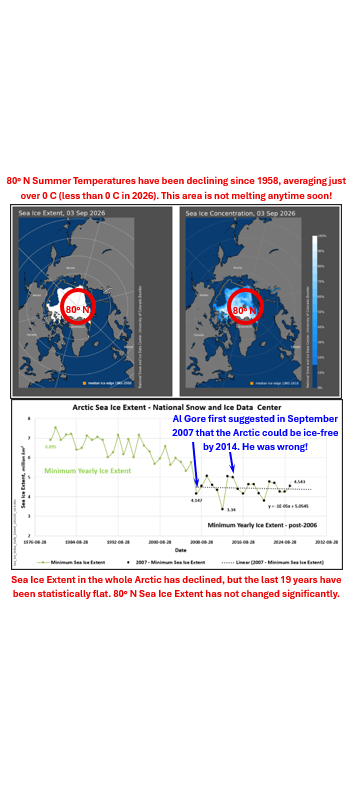
OPS-84 The 2026 Arctic summer melt season north of 80° has come to an end. There were only 4 days that averaged above 0 °C (barely), the last one on August 6th, 2026. More surprisingly only 15 days in July managed to rise above 0 °C (again, just barely). And June, not to be outdone never managed to average above 0 °C. That is a total of 19 days with an average daily temperature above 0 °C (and again, just barely). If Al Gore and his accolades bothered to look at the empirical data, they might not have been so quick to declare (erroneously) that Arctic Sea Ice was about to disappear.
#climatechange #delaythegreen #globalwarming #showusthedata
For 68 years, the average temperatures during the summer melt season (all three months) have been declining (noticeably for June and July, slightly for August). That is in sharp contrast to the steadily rising Greenhouse Gas (primarily CO2) concentrations that are supposed to be driving our temperatures higher. That 68-year period covers the entire Mauna Loa CO2 dataset (a period where 85% of humanity’s emissions occurred) and somehow temperatures keep falling.
The COLDEST EVER (to use alarmist terminology) 80° N Arctic temperatures, which were facilitated by a dramatic drop in temperatures in June/July this year (2026), has been the main story in the social media recently (with crickets from the mainstream media). But the more important story is the steady decline in temperatures for every month of the summer melt season (June, July, and August) beginning in 1958 and the anti-correlation with rising atmospheric CO2 concentrations. An ice-free Arctic Sea will not happen until the 80° N summer (JJA) temperatures reverse their 68-year temperature declines. Despite a 556% increase (from 281737 Gt in 1958 to 1849124 Gt in 2024) in cumulative human CO2 emissions (which represents 85% of all humanity’s emissions) and a 36% increase (114.4 ppm, 315.71 to 430.15 ppm) in atmospheric CO2 concentrations, 80° N temperatures continue to decline. CO2 increases have obviously not produced rising temperatures in the Arctic’s far north for the last 68 years. And given that CO2’s warming capacity decreases logarithmically as CO2 rises, how can additional CO2 possibly arrest those long-term 80° N temperature declines?

A more detailed discussion can be found in my CSS-84 – Arctic Sea – Average Temperature post. Here are some additional papers/posts that provide additional context to this discussion.
Climate Short Story (CSS)
CSS-69 – CO2’s Cooling Parameters
CSS-84 – Arctic Sea – Average Temperatures
One Page Summary (OPS)
OPS-80 – CO2 Affects Temperature but Does CO2 Drive Climate?


