
Holocene CO2 and the Magnetic Field
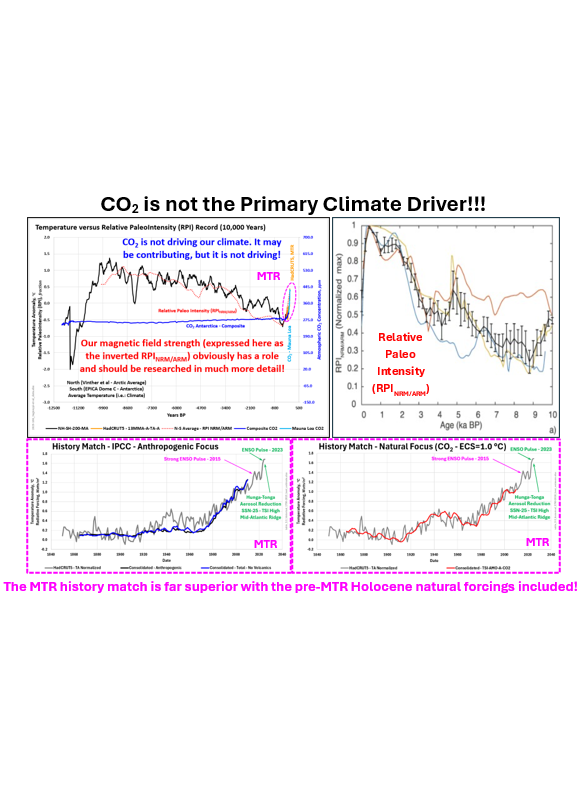
OPS-83 The All CO2, All the Time alarmist narrative suggests that anthropogenic forcings (primarily greenhouse gases, led by CO2) are the primary climate driver. The empirical data says otherwise. CO2 simply does NOT correlate with the Holocene climate (temperature, sea level, glacier advance/retreat, etc.). Temperatures fluctuated significantly and often for 10,000+ years over the Holocene while atmospheric CO2 concentrations remained virtually flat. CO2 was obviously NOT driving the Holocene climate. Conversely, the Earth’s magnetic field strength does generally correlate with global temperatures. The magnetic field strength is obviously more important than CO2 in a ‘climate change’ discussion but it has not been given the focus it deserves.
#climatechange #delaythegreen #globalwarming #showusthedata
The magnetic field strength role (Holocene chart attached) is not well understood. However, in general, a lower magnetic field strength allows more energy to enter our biosphere (more energy, higher temperatures), and a higher magnetic field strength limits the energy that enters our biosphere (less energy, lower temperatures). Note, there is a lot more energy bombarding our planet than the IPCC’s Total Solar Irradiance (TSI) focus. And there are far more energetic TSI reconstructions available than just the IPCC’s ‘best estimate’ (the Matthes et al 2017 option, just one out 40+ options).

The magnetic field strength is likely just one component of the overall climate forcing. And the weighting of that forcing is certainly open for debate. The magnetic field strength correlation is very likely an expression of all the various electromagnetic and gravitational interactions that occur within our solar system (including external sources). These would include the longer-term Milankovitch cycles which are expressed here in the sharp temperature rise out of the Last Glacial Maximum (LGM) into the Holocene Climate Optimum (the first warm period), then followed by the general temperature decline through the Holocene’s Neoglacial period (towards the next glacial maximum).
On shorter time frames, the gravitational and electromagnetic interactions between the gas giant orbits and our sun become dominant, creating the significant and higher frequency fluctuations along the general Holocene temperature trends. These would include (but are not limited to) Jupiter’s ±60-year orbital eccentricity that is likely driving the many 60-year cycles present in our biosphere (the AMO, cloud coverage/sunshine hours, fish stocks, sea ice cover, etc.), and the ±1,100-year Bond/Eddy solar cycles that show up in Greenland’s temperature history as alternating interstadials (warm periods (i.e.: Minoan, Roman, and Medieval)) and stadials (cold periods (i.e.: the Greek Dark Ages, the Dark Ages, and the Little Ice Age)). We are currently experiencing the Modern Warm Period, the most recent interstadial in the Bond/Eddy solar cycle, which will likely be followed by the next cold stadial. The warming started during the 1600s (the Maunder Minimum, the depths of the LIA, centuries before CO2 concentrations began rising). More discussion can be found in my CSS-75 – Solar Forcing Discussion post.
Note, the magnetic field strength data frequency is 200 years which does not capture the shorter cycles very well. What should concern humanity is the sharp drop in magnetic field strength (approaching 50%) over the last ±400 years. Modern technology has confirmed that Earth’s magnetic field strength is weakening, at an accelerating pace. That leaves us vulnerable to the sun’s variability. The last major solar flare/Coronal Mass Ejection (CME) occurred in 1859 (the Carrington event). Our magnetic field strength was still close to its peak, and that society was not nearly as technologically advanced as we are now. That ±X100 flare caused minor problems with their telegraph infrastructure. That same flare today would cause severe problems if our magnetic field strength was still near its peak. With our weakened magnetic field strength, the implications could be devastating.
And unfortunately, our sun is capable of much stronger outbursts (a real existential threat). During the last major geomagnetic excursion (the Tianchi), we were hit by Solar Flares in the ±X1000 range. Inconsequential in a pre-modern technology society, but a dystopian future for our society. We are experiencing a significant geomagnetic excursion right now. That excursion kicked off during the Maunder Minimum and is solar related (through the solar system’s electromagnetic and gravitational interactions). The excursion rate accelerated significantly in the 1850s, coinciding with the Carrington Event. Also coincidentally, sea levels that had been declining, suddenly began rising. Glaciers that had been advancing, transitioned to retreating. All before atmospheric CO2 concentrations began rising significantly. The 1850s inflection point was natural, not anthropogenic, easily visible in the attached chart.

To summarize, The Holocene climate fluctuated often and significantly with little to no anthropogenic influence. CO2 did not correlate with and was not driving the Holocene climate (a 10,000+ year period). The claim that anthropogenic forcings (primarily CO2) are driving the climate because temperatures and CO2 concentrations correlate over the Modern Temperature Record (MTR, 1850 to the present), is scientifically ludicrous. There are natural forcings (solar activity, directly and indirectly) that can be used to model the MTR better than anthropogenic forcings alone. Not surprisingly, the best history matches use reasonable natural forcings along with unbiased anthropogenic forcings. More discussion can be found in my CSS-71 – IPCC Model/Theory Shortcomings and CSS-71 Revisited posts.
CO2 is NOT the primary climate drive (a statement of fact, not an opinion). The interactive electromagnetic and gravitational forces acting on and within our solar system are ultimately driving our climate. These interactions affect the magnetic fields of the sun and our planet, which affects the energy that the sun directs towards us, and the amount of energy that our planet absorbs. The energy from the sun drives our ocean and atmospheric circulations/cycles which play a huge role in our climate. The simplistic, unscientific focus on anthropogenic forcing is a dangerous, ideological approach to ‘climate science’. The empirical data available over the Holocene obliterates the insane need to restrict CO2 emissions (a molecule as important to life as O2 and H2O). Food for thought for the openminded.

CSS-71 – IPCC Model/Theory Shortcomings – Revisited
CSS-75 – Solar Forcing Discussion
CSS-78- Weakening Electromagnetic Field
CSS-79 – A Commonsense Look at Climate Change
Here are some additional papers/posts that provide additional context to this discussion.
Improving the reconstruction of Holocene geomagnetic paleosecular variation in the Antarctic region – Sagnotti et al (January 2026)
https://www.sciencedirect.com/science/article/pii/S0031920125001815#bb0155
Climate Short Story (CSS)
CSS-69 – CO2’s Cooling Parameters
CSS-71 – IPCC Model/Theory Shortcomings
CSS-71 – IPCC Model/Theory Shortcomings – Revisited
CSS-74 – Climate Tipping Points
CSS-75 – Solar Forcing Discussion
CSS-78 – Weakening Electromagnetic Field
CSS-79 – A Common Sense Look at ‘Climate Change’
CSS-82 – Building a Better, More Realistic Climate Model
One Page Summary (OPS)
OPS-80 – CO2 Affects Temperature but Does CO2 Drive Climate?
https://climatechangeandmusic.com/co2-affects-temperature-but-does-co2-drive-climate/


Great content! Keep up the good work!