
A Common Sense Look at ‘Climate Change’
CSS-79 The earth’s “climate system is a coupled non-linear chaotic system, and therefore the long-term prediction of future climate states is not possible”. Those are the IPCC’s words, not mine. Yet somehow, the prevailing ‘climate change’ alarmist narrative believes that our future climate can effectively be predicted using just anthropogenic forcings (focused on CO2). There are many more natural forcings that are being minimized or outright ignored by the IPCC. Common sense would dictate that your chances of modeling a complex “unpredictable” system (like our climate) effectively, would incorporate more than just the current simplistic, unscientific All CO2, All the Time alarmist narrative. This discussion includes a common sense look at what has happened and what will likely happen with our climate in the future.
#climatechange #delaythegreen #globalwarming #showusthedata
Quick Summary
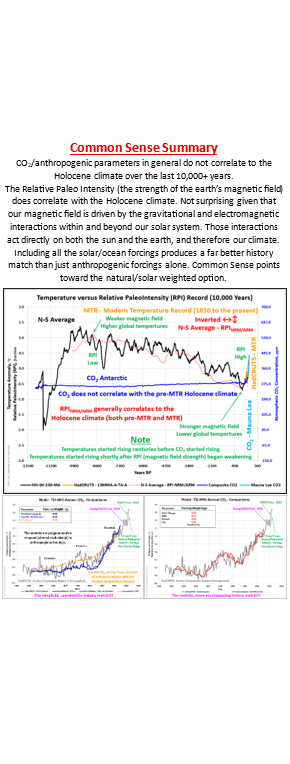
The previous discussion has been technically complex, but applying some common sense lends itself to a realistic expectation for the radiative forcing allocations for both historical and forecasted ‘climate change’. Starting with the climate over the Holocene (the last ±12,500 years) puts CO2’s role in perspective. The climate changed dramatically and often throughout the Holocene while CO2 remained virtually flat (pre-1850). Common sense dictates that CO2 is obviously not the primary climate driver on our planet, given that the climate (i.e.: temperature, sea level, ice extent, etc.) fluctuated dramatically for approximately 98.5% of the Holocene’s 12,065+ year history. CO2 does not correlate with the Holocene climate history and therefore cannot be causal with respect to the Holocene climate. Are there any parameters that do correlate with the general Holocene climate trends? There are many, starting with the Milankovitch cycles.
The chart below compares the average global temperature (the average of the Vinther et al Arctic and the Antarctic EPICA Dome C datasets), the global atmospheric CO2 concentration (from Antarctic ice cores), and the Relative Paleo Intensity (RPI, essentially an indication of the earth’s magnetic field strength). Why does the RPI correlate with the Holocene climate? A complicated question, but the RPI is very likely a representation of the gravitational and electromagnetic interactions of the solar system and beyond. That would include the Milankovitch cycles as well as the direct contribution (i.e.: lower magnetic field strength means more solar energy enters our biosphere, contributing to the changes in our climate). The RPI data resolution is 200 years, so the many shorter solar/ocean cycles are not reflected in the RPI data. RPI correlates to the Holocene climate, CO2 does not!

There is some CO2 correlation over the last 176 years (1850 to 2026) which is used by the alarmist community to push the ‘global warming/climate change/emergency’ narrative. But better correlations can be achieved by using just natural forcings (focused on solar activity and ocean cycles (the Atlantic Multi-decadal Oscillation (AMO), Pacific Decadal Oscillation (PDO), El Niño Southern Oscillation (ENSO), etc.). Connolly, Soon et al in their 2023 paper, “Challenges in the Detection and Attribution of Northern Hemisphere Surface Temperature Trends Since 1850”, reviewed 27 of the 40+ available TSI reconstructions (which included the one TSI reconstruction recommended by the IPCC) and found that many of the reconstructions produced better statistical fits than the IPCC’s anthropogenically focused model projections.
Note, every one of those 40+ TSI reconstructions would produce better historical correlations (including the IPCC’s one option) if the TSI is treated as a proxy, not just as an absolute value. TSI is not the only solar forcing acting on the planet, but it is the only one recognized by the IPCC in their models. TSI, as a proxy accounts for the IPCC’s ignored solar forcings. Adding in the ocean cycles, just tightens up the Connolly Soon et al TSI correlations.
So, the Modern Temperature Record (MTR, 1850 to the present) can be closely modeled using the IPCC’s anthropogenic ideology (focused on greenhouse gases, primarily CO2) or Total Solar Irradiance (TSI, using reconstructions directly or as a proxy). Which one provides the correct answer? Trick question and this is where common sense comes back into play. The answer is neither, on their own. Our climate is governed by all these factors. The dilemma comes down to the weighting for each parameter. The following correlations were pulled from the IPCC’s ‘best estimates’ (below left). The correlation (below right) starts with the IPCC’s ‘best estimates’, adds in just one of the ocean cycles (the AMO) and substitutes out the IPCC’s one TSI reconstruction for an average of six of the remaining 40+ available TSI reconstructions.

The IPCC ‘best estimates’ are obviously anthropogenically focused. The Total Anthropogenic Radiative Forcing (RF) curve is effectively a layover of their Total RF curve (i.e.: solar and ocean forcings are minimized and/or outright ignored). Which of these two history matches (anthropogenically or naturally focused) reflects the MTR better? I am going to go with the naturally focused option, which could be tightened up by adding in the other major ocean cycles. Which of these two history matches (anthropogenically or naturally focused) would have any chance of history matching the pre-MTR Holocene temperatures/climate? Definitely not the IPCC ‘best estimate’ option. The complete lack of CO2/temperature correlation over the Holocene produces the Holocene CO2 Conundrum. The climate changes significantly and often without any CO2 contribution. Those natural forcings have been active pre-MTR, were active during the MTR, and will be active in the future (just not in the climate models which are self acknowledged to run too hot and use implausibly high emission scenario).
What does that future look like? There are many factors that can and will come into play. If you believe the climate models, you are relying on a simplistic, unscientific narrative that focuses on greenhouse gases (primarily CO2) and the warming amplification through their positive water vapor feedback hypothesis. The problem, the models use a range of CO2 Equilibrium Climate Sensitivities (ECS, 1.8 °C to 5.7 °C) that all produce temperature projections that are greater than observations (i.e.: they all run too hot, and the IPCC obviously does not know what CO2’s ECS value is). CO2’s warming capacity declines exponentially as CO2 concentrations rise and is approaching saturation. Combined with CO2’s two cooling properties (rising leaf cover and co-aerosol production, neither of which is included in the models), CO2 warming may be or soon will be a non-issue. The models have proven to be inadequate. Common sense dictates that they are not reliable and are therefore not fit for policy decisions.
The models outright minimize/ignore the natural forcings (solar and oceanic). But those natural forcings are still active, as they were throughout the Holocene. The Milankovitch cycles are trending colder (although slowly). The Atlantic Multi-decadal Oscillation (AMO, a key climate driver) is just dropping into its 30-year cold phase. The Bond/Eddy solar cycle (blatantly visible in the Greenland temperature data) is approaching its tipping point. The temperature rise out of the Little Ice Age (which began centuries before CO2 began rising) will be followed by a sharp drop into a prolonged cold period. The timing (probably soon) and magnitude are open for discussion, but the process has been repeated regularly throughout the Holocene. Shorter term solar activity is also likely to play a cooling role as we move into a new Grand Solar Minimum (GSM, like the Maunder Minimum in the late 1600s).
We should be applying some common sense to our future possibilities. Cooling is far more likely and dangerous than warming. Net Zero policies (greenhouse gas emission reductions in general) are an uneconomic, ineffective, dangerous ideology that is wasting taxpayer’s money, producing no measurable change in climate, hastening our economic suicide, and ignoring the energy, food, financial, etc. crises that we are already facing. Rather than advocating weather dependent renewable energies (to a world that is supposedly headed for a future of weather extremes, it is not), the focus should be on the energy security realities we are already facing. The world is not transitioning off hydrocarbon energy and wants/needs our oil, natural gas, coal, and nuclear energy resources. Our resource industries are the life blood of this country, and we need to step up and provide those resources (with some of the world’s highest ethical, environmental, technical, and economical standards) to the world. Hopefully common sense will prevail and give our children and grandchildren a chance for a decent future. One without the destructive, totalitarian path we are currently on.
For more perspective and more detailed analysis, you can also check out some of the following posts.
IPCC Working Group 1 (WG1) Sixth Assessment Report (AR6) Annex III Extended Data
https://zenodo.org/records/5705391
Challenges in the Detection and Attribution of Northern Hemisphere Surface Temperature Trends Since 1850 – Connolly Soon et al 2023
https://iopscience.iop.org/article/10.1088/1674-4527/acf18e
Global Green Up Slows Warming – NASA
Link (may have to inputted manually): science.nasa.gov/earth/earth-observatory/global-green-up-slows-warming-146296/
Improving the reconstruction of Holocene geomagnetic paleosecular variation in the Antarctic region – Sagnotti et al (January 2026)
https://www.sciencedirect.com/science/article/pii/S0031920125001815
Climate Short Story (CSS)
CSS-56 – The Holocene & Solar Activity
CSS-69 – CO2’s Cooling Parameters
CSS-71 – IPCC’s Model/Theory Shortcomings
CSS-71 – IPCC’s Model/Theory Shortcomings – Revisited
CSS-74 – Climate Tipping Points
CSS-75 – Solar Forcing Discussion
CSS-78 – Weakening Electromagnetic Field


