
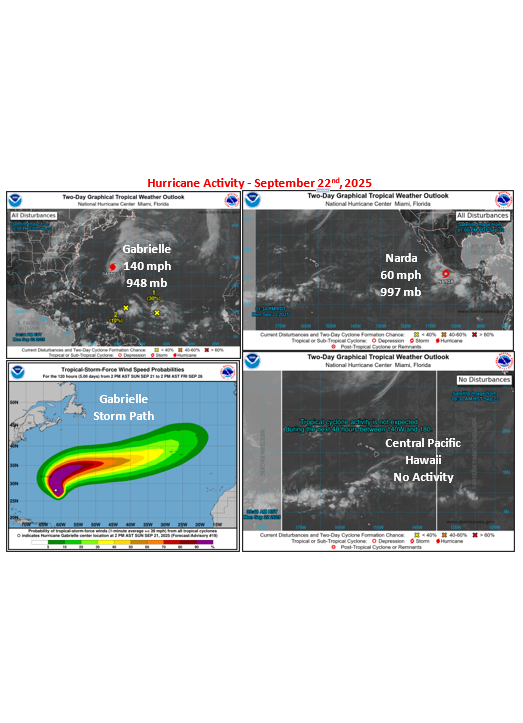
Hurricane Update – September 2025
CSS-70 Updating the yearly hurricane data yielded no surprises. The global trend for hurricanes and major hurricanes (this weather category’s extreme event) is still down. And looking quite dismal for the alarmists’ 2025 hopes. Confirming that anyone espousing that hurricane activity is becoming more frequent and/or more intense are either ignorant of the empirical data or they are simply lying.
#climatechange #delaythegreen #globalwarming #showusthedata
As a quality control measure, I looked at two additional data sets along with the Weather Underground data set that I have traditionally used. There were some minor differences, but nothing that would affect any of my previous discussions. They all confirm hurricane activity is declining as CO2 concentrations have been rising. Not great for the All CO2, All the Time narrative or “the science” of “attribution studies”. It is hard to attribute hurricane number and intensity increases to ‘climate change’ (i.e.: CO2) when hurricane numbers and intensity are decreasing.
This post focused on the Wikipedia data despite my general feelings for the site. Wikipedia (a regular purveyor, in my opinion, of mis-, dis- and omiss-information on any topic that is politically related) is no friend of the climate realist community. In this case the data compares closely with the Our World in Data (OWID) and the Weather Underground. Any of the datasets can be used. OWID is the easiest dataset to work with, but the data is limited to the North Atlantic and only updated to 2022.
Wikipedia summarizes the yearly forecasts for the North Atlantic. Out of curiosity I plotted the last 6 years of those forecasts. Named storms were equally under or overestimated. Hurricanes and major hurricanes tended to be overestimated. The University of Pennsylvania, their first forecast was in 2023, provided some comic relief. Their 2023 forecast (12 – 20 named storms) just encapsulated the 20 named storms recognized in 2023. Did they decide their algorithms were too conservative based on the 2023 results? They drastically overestimated the 2024 season by a wide margin (27 to 39 versus just 18 named storms). They were not alone in their overestimation, but they were a very noticeable outlier. Was that just propaganda? Did Michael Mann have his thumb on the scale? We may never know. Only the North Carolina State University (NCSU) had a tight range around the actual 18 named storms. U. Penn came back down to realistic levels for 2025, but Mother Nature is already making all the current forecasts look a little over aggressive.
Climate scientists have difficulty forecasting hurricane activity over short time periods (less than a year). But we should believe the forecasts that are acknowledged by the climate modeling community to run too hot and in many cases are based on implausibly high emission scenarios?


Weather Underground Hurricane Activity
Wikipedia – Hurricane Activity

For more perspective and more detailed analysis, you can also check out some of the following posts.
Wikipedia – Hurricanes
Tropical cyclones by year – Wikipedia
https://en.wikipedia.org/wiki/Tropical_cyclones_by_year
Our World in Data – Hurricanes/ACE – North Atlantic
https://ourworldindata.org/grapher/frequency-north-atlantic-hurricanes
https://ourworldindata.org/grapher/ace-north-atlantic-hurricanes
Weather Underground – Hurricanes
Hurricane & Tropical Cyclones | Weather Underground
https://www.wunderground.com/hurricane
Climate Short Story (CSS)
CSS-66 – Are Hurricanes Just Earthspots?
CSS-52 – Extreme Weather Events
CSS-37 – Hurricanes – Accumulated Cyclone Energy (ACE)
One Page Summary (OPS)
OPS-75 – Hurricane – Update – 2023
OPS-63 – Hurricane Update – 2022 Season
OPS-57 – Hurricane Update – 2021 Season
OPS-46 – Hurricane Update – 2020 Season


