
What Happens After Net Zero?
OPPS-33 This post summarizes Net Zero’s costs/benefits differently than my previous post (OPPS-32 – Liberal – Net Zero – Cost Benefit). A variety of expenditure and temperature estimates are included but the cost benefit analysis is limited to the federal government’s own official numbers from 2022.
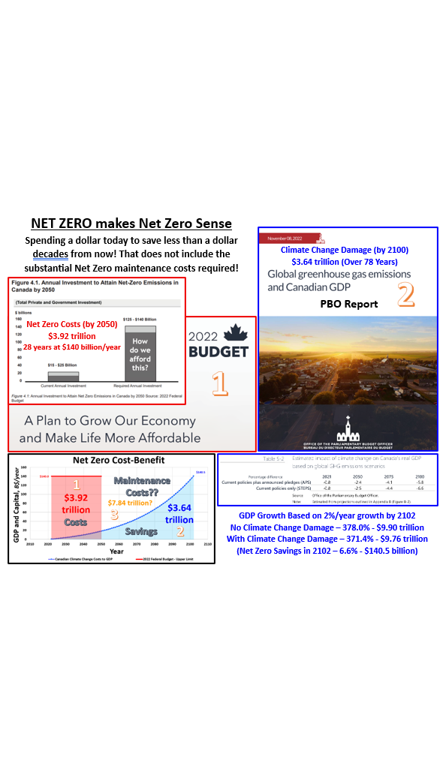
Using the Federal government’s own numbers (the 2022 Budget and the PBO report on ‘Climate Change’ and GDP), we (Canadian taxpayers) will be spending more money ($3.92 trillion) than we save ($3.64 trillion) on ‘Climate Change’ damage. When you factor in the time value of money, the difference in spending ($2.63 trillion) and savings ($0.70 trillion) is much more pronounced. We are effectively trading dollars (no net benefit, a $280 billion loss/waste) in the undiscounted scenario, but when monies are rightfully discounted (in this case at 3%) we are wasting $1.93 trillion.

And what do we get for those wasted trillions? A temperature rise reduction of just ±0.004 °C (using the “IPCC science”). That works out to $9.8 trillion for every 1/100th of a °C of temperature rise reduction.
#climatechange #delaythegreen #globalwarming #showusthedata
Net Zero does not make economic sense using the government’s official cost (likely low) and benefit (likely high) estimates. The picture gets even murkier when we consider what is required after we reach Net Zero. The costs do not stop in 2050. Maintaining Net Zero will be just as, and more likely more expensive than achieving Net Zero. Wind and solar farms must be rebuilt every 20 to 25 years or Net Zero goes away (assuming we have the raw materials to even make that happen). The same goes for Battery Storage and Electric vehicles. There is also another problem with post-2050 expenditures. They do not add any future temperature reductions (i.e.: we are already at Net Zero).
The question may be moot anyway, given that we do not likely have the resources (material or financial) to even reach Net Zero. And given current global events, humanity’s propaganda induced desire for Net Zero also appears to be thankfully waning. Nuclear is making gains, technically and regulatorily. Natural gas has been recognized as a valid “transition” fuel as energy security has rightfully been recognized as important. Financial security has forced countries around the world to move back to or toward coal powered generation (China, India, Germany, Japan, US, etc.). Developed countries are reevaluating their approach to oil, natural gas, and coal (energy in general) development. Examples are the US (drill, baby, drill), New Zealand (abandoning Net Zero), and Norway (turning away from electrical interconnection while increasing hydrocarbon exploration/production). Canada needs to reconsider their desire to be a leader in a world where most of the world is not following.
I would like to paint a picture of what our near future may unfortunately look like. Will the mainstream media endorse the dystopia we are forging given their “if it bleeds, it leads” philosophy? We have already set the table for disaster by over aggressively trying to force an energy transition on the world (required or not). On the back of our ideological ‘green initiatives, Canada’s financial situation has deteriorated (stagnant GDP/capita growth, falling business investment/capita growth, excessively high and rapidly rising deficits and debt, unaffordable housing, rising poverty statistics, higher food bank use, etc.). Those issues will get magnified, since Net Zero will require a 5 to 6-fold increase in expenditures (according to the 2022 Canadian Federal Government’s budget). We cannot afford that increase and are destined for economic suicide should we try.
We are already feeling the technical/environmental ramifications of our intermittent, unreliable renewable implementations. The risk of black/brown outs is increasing as renewable volumes are added (i.e.: California, Texas (2021), and Spain/Portugal (2025) quickly come to mind). Even in Alberta where we have a strong gas fired back-up, we came close (several times) this winter to grid failure when we needed that energy the most. We have days at a time (usually during extreme hot and cold periods) where we have no wind or sunshine with no meaningful Battery Energy Storage System (BESS) backup. Without a fully functional base load generation backup option, we will face serious consequences. Layer on battery fires, bird/bat/cetacean kills, natural habitat/farmland destruction, environmental pollution (fibreglass shedding, combustion byproducts, end of life disposal, etc.), accelerated mining impacts (strip mining, leaching ponds, runoff, etc.), climate impacts (warming in solar farms, dry conditions downstream of wind farms, minimal carbon footprint improvement, etc.), etc. and you have to question why we are on this ideological path to Net Zero.
The discussion (and Net Zero ideology) should stop here, but we will play the scenario out. It is 2050, and we have somehow managed to achieve Net Zero and we have not bankrupted ourselves. Time to throw another few trillion dollars at the perceived problem and start rebuilding the aging renewable generation facilities. Can we make it through another round of renewable resource development? Not likely given our financial and renewable raw material resources are probably tapped out or close to it. After decades of adding unreliable, “renewable” options, our electrical grids have become more susceptible to disruptions. Future additions will just compound the problems. We, in Alberta are luckier than many jurisdictions, since we have a strong natural gas backed baseload generation. When the “energy transition” falls apart (and it will), we already have a fully capable natural gas electrical generation system in place. And just to stir the pot a little, that will give us time to rebuild our coal generation facilities.
Other jurisdictions, that have wholeheartedly embraced the Net Zero ideology will find that their electrical grids will collapse quickly. The Battery Energy Storage Systems will be useless without viable generation for recharge (without financial and raw material resources, wind and solar generation cannot be rebuilt). Nuclear, hydro, geothermal, hydrogen, etc. still need more time, technological improvements and/or less regulatory roadblocks. They will not be the path forward. Even natural gas and coal (the reliable, affordable baseload option) will take time to reestablish. Time that these jurisdictions will not have. Some developing countries are waking up (the US, New Zealand, Norway, NOT Canada). But the developing countries (China, India (and soon to be followed by Africa)) are leading the way and have wholeheartedly embraced more coal generation. These countries will be prepared to move forward when the renewable dream implodes. Those not prepared and overly dependent on “renewable” options will find themselves in a dystopian nightmare, life without electricity for a sustained period of time.
As mentioned earlier, we are setting ourselves up for disaster by trying to electrify all aspects of our society. We are already overly dependent on electricity. In my 2022 post (OPPS-20 – Why are We Putting All Our Eggs in One Basket?) and 2023 post (CSS-36 – Solar Flares and CMEs) I had a look at the potential risk of solar flares and CMEs. We have lived through a period of relative solar calm. The most significant large solar flare/CME we have experienced was the Carrington Event in 1859. Had that happened in today’s modern society, we would have experienced massive, devastating grid failures around the globe. Some well-placed Electro Magnetic Pulse (EMP) blasts would produce the same result and are possible given the state of world affairs. My CSS-36 post included the statement below.
“We can, in general, survive the climate effects of a large Solar Flare/CME. The energy infusion will (as it has in the past, 1859, 1921, 2012, etc.) temporarily increase global temperatures (not a major problem). Our struggle will come from the virtually permanent loss of our access to electricity.”
I included this statement because the dates shown above were all strong enough events that severe grid failures were a distinct possibility if they had hit earth directly today (especially given our significantly weakened electromagnetic field protection). Had I waited for one more day to post, I could have included the March 12th, 2023, solar flare and CME in the statement. The 1859 (±X50) and 1921 solar flares/CMEs produced minimal damage despite direct hits on the planet since our technologies were not as advanced as they are today. The 2003 (±X45), the 2012 (±X50), and the 2023 events were luckily not directed at earth. However, we may be living on borrowed time, because the sun is capable of much higher outbursts than X50. Unfortunately, our weakening electromagnetic field strength and ever more unreliable electrical grids are opening us up to severe damage from weaker solar flares/CMEs.
The X1 to X10 events that have been, in my opinion, a little to regular recently, have caused problems with satellites, communication systems, etc. But they have also provided direct indications of our weakening electromagnetic field. Those awe inspiring, spectacular auroras that are visible down into the lower latitudes and more frequent, stronger geomagnetic storms are being produced by continually weaker solar flare/CME events. Rare (red sprites) and new (Strong Thermal Emission Velocity Event (STEVE)) atmospheric events are becoming common along with widespread and more lightning events. Any chance the weakening magnetic field strength could be playing a role in our ‘climate change’ since 1850? Sea levels were declining until the 1850s despite a virtually flat CO2 concentration. Something changed dramatically in the 1850s and it was not CO2. Just a coincidence, I am sure.
Why do I bring up solar flares/CMEs (a real existential threat) in this post? Because we should be spending the trillions we are wasting on the completely unnecessary Net Zero initiatives, on hardening our electrical grids and infrastructure to withstand a direct hit from a large solar flare/CME. When it happens and it will, your electric car will be useless. There will be no modern industry to rebuild our electrical grids. There will be no refrigeration or central heating. There will be no food (or any other product) delivery to your grocery store, let alone your house. I suspect Mother Nature will put us back to a Net Zero state (if we do not address this issue) well before our misguided “leadership’s” 2050 target date. Either way we are in trouble. At least Mother Nature will not tax and torture us to death to get us there.

OPS-55 – The State of Climate Science
PSS-6 – Climate Change – Quick Cost-Benefit Analysis
Additional discussion can be found in the following links.
2022 Canadian Federal Budget
https://www.budget.canada.ca/2022/home-accueil-en.html
2022 PBO Report – Global greenhouse gas emissions and Canadian GDP
In What Reality Does Net Zero Make Sense?
Energy & Climate at a Glance – Canadian Edition 2024
Net Zero Averted Temperature Increase – Lindzen, Happer, van Wijngaarden (June 2024)
https://arxiv.org/abs/2406.07392
Climate Short Story (CSS)
CSS-36 – Solar Flares and CMEs
One Page Political Story (PSS)
OPPS-20 – Why Are We Putting All of Our Eggs in One Basket?
OPPS-32 – Liberal – Net Zero – Cost Benefit
Political Short Story (PSS)
PSS-6 – Net Zero – Quick Cost Benefit Analysis


